A Practical Guide to Personalized Product Suggestions Through WhatsApp
Introduction
Imagine visiting an online store, exploring a few products, and then receiving a WhatsApp message recommending something completely unrelated to your interests. Would you engage with it?
Many customers ignore promotional messages because businesses focus on selling products instead of understanding what people need.
Personalized recommendations change this experience by connecting product suggestions with customer preferences, previous interactions, and purchasing decisions.
For businesses using the WhatsApp Business Platform, this approach can support more relevant communication throughout the customer journey. Customers can discover products, request additional information, compare options, and get help directly through a familiar messaging channel.
This guide explains how businesses can build a practical WhatsApp recommendation strategy, use automation effectively, and improve the shopping experience without overwhelming customers.
Why Generic Product Promotions Often Fail
Sending the same promotion to every customer may seem convenient, but it rarely addresses everyone’s needs.
A first-time visitor, a returning customer, and someone who has already purchased a product may require completely different messages.
For example, a first-time shopper might need product information, while a returning customer may appreciate recommendations related to a previous purchase.
Generic campaigns often struggle because they:
- Ignore differences in customer preferences.
- Offer products that may not be relevant.
- Arrive at inconvenient times.
- Provide too much information in a single message.
- Focus on immediate sales instead of customer satisfaction.
A personalized strategy starts by identifying what each customer is trying to accomplish and offering a useful next step.
Build a Customer-Centred Recommendation Strategy
Before launching a WhatsApp recommendation campaign, businesses should establish a clear process for deciding what to recommend, who should receive the message, and what action the customer can take.
Step 1: Divide Customers into Meaningful Groups
Customer segmentation helps businesses send different recommendations to different audiences.
Rather than treating the entire customer database as one group, create segments based on appropriate business information.
Possible segments include:
- First-time buyers.
- Repeat customers.
- Customers interested in specific product categories.
- Customers who requested information but have not purchased.
- Existing customers who may benefit from complementary products.
- Customers who have expressed interest in a new feature or service.
For example, an electronics retailer could create separate groups for customers interested in mobile accessories, home appliances, and computer equipment.
Each group can then receive recommendations relevant to its interests.
Segmentation should be based on reliable information, and businesses should avoid making unsupported assumptions about individual customers.
Step 2: Connect Recommendations to Customer Intent
A useful recommendation answers a question the customer already has or helps them complete a task.
Consider an online furniture store.
A customer who purchases a dining table might appreciate suggestions for matching chairs. Someone who asks about a compact desk, however, may be more interested in space-saving furniture.
Although both customers shop at the same store, their immediate needs are different.
Businesses can identify customer intent through appropriate sources such as:
- Previous purchases.
- Product enquiries.
- Customer-selected preferences.
- Website interactions where data collection is permitted.
- Conversations with customer support.
- Responses to previous campaigns.
The recommendation should follow the available evidence rather than assume that every customer wants additional products.
Step 3: Design Recommendations for Each Stage of the Customer Journey
Customer needs change as they move from discovering a product to purchasing and using it.
Businesses can adapt their messages to these stages.
Discovery stage
Introduce products that match the customer’s stated interests.
Example:
“Hi [Name]! You asked about our home-office collection. Would you like to see some options for smaller spaces?”
Consideration stage
Help customers compare products and understand their differences.
Example:
“Both [Product A] and [Product B] may suit your needs. Would you like a comparison of their main features?”
After purchase
Recommend compatible products or share useful information related to the purchased item.
Example:
“Thanks for purchasing [Product]. If you need help getting started, we can share a quick setup guide.”
Repeat purchase stage
Inform interested customers about relevant new arrivals or products they may need again.
Example:
“Hi [Name]! The [Product Category] collection has been updated. Would you like to see the latest options?”
Not every stage requires a sales message. Sometimes, helpful guidance is the best way to build a lasting customer relationship.
How WhatsApp Automation Supports Product Recommendations
As a business grows, maintaining personalized communication manually can become challenging.
Automation helps businesses respond consistently by using predefined conditions, customer segments, and messaging workflows.
For example, a business might create a workflow that identifies customers who have requested product information and sends an appropriate follow-up, provided the customer has given the required permission and the message complies with applicable WhatsApp rules.
Automation can also support several practical activities.
Automated Follow-Ups
When customers request additional details, a workflow can help ensure that their enquiries receive timely attention.
Follow-ups should be relevant, appropriately spaced, and stopped when they are no longer useful.
Product-Based Customer Segmentation
Businesses can organize customers according to their interests and interactions, making it easier to deliver relevant recommendations.
Frequently Asked Questions
Automated responses can answer common questions about product specifications, delivery options, availability, and other supported topics.
When a question requires human judgement or additional assistance, the conversation should be transferred to an appropriate team member.
Campaign Management
Businesses can organize approved promotional campaigns for customers who have opted in to receive the relevant messages.
The WhatsApp Business Platform has specific requirements for business-initiated messaging, templates, and customer service conversations. Businesses should confirm that their workflows follow the current rules.
Sales Team Coordination
When a customer requests a quotation, asks for a product comparison, or needs additional support, automation can help direct the conversation to the appropriate team.
This makes it easier to combine automated communication with human assistance.
Make WhatsApp Recommendations Interactive
A good recommendation should give customers control over what happens next.
Instead of asking customers to read a long product description, present a small number of relevant choices.
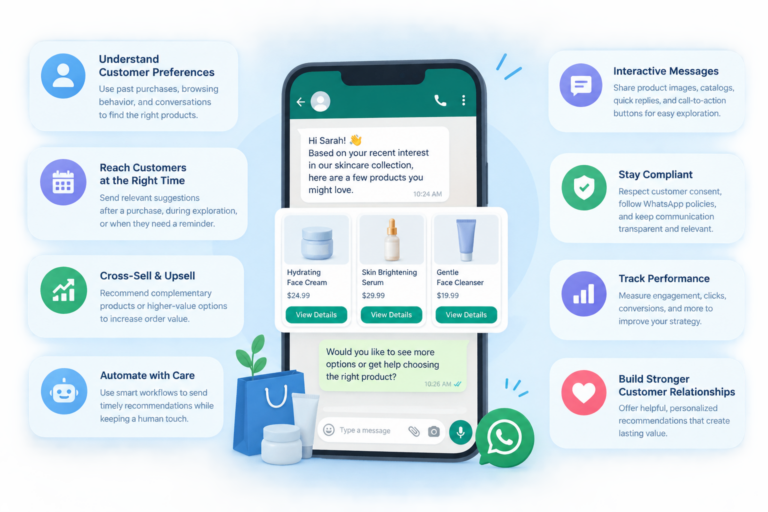
Depending on the messaging integration and supported WhatsApp features, businesses can use product catalogs, images, links, interactive buttons, and structured lists.
For example, a home-appliance business might send:
“Hello [Name]! Which type of appliance are you looking for?”
- Kitchen appliances.
- Cleaning appliances.
- Home comfort products.
Once the customer selects a category, the business can share suitable options.
This approach has several advantages:
- Customers can communicate their preferences.
- Businesses can avoid sending unrelated products.
- Product discovery becomes easier.
- Sales teams can better understand customer requirements.
- Follow-up conversations become more focused.
Keep the number of choices manageable and provide a clear way for customers to request human assistance.
Practical WhatsApp Recommendation Campaigns
Here are examples of how different businesses can apply this strategy.
Campaign 1: Complementary Products
Business type: Online retail.
Objective: Introduce useful accessories after a purchase.
Message:
“Hi [Name]! You recently purchased [Product]. Customers looking for additional convenience may also be interested in [Accessory]. Would you like to see its features?”
The recommendation should be relevant to the purchased product rather than selected solely to increase order value.
Campaign 2: Product Discovery
Business type: Fashion retailer.
Objective: Help customers find products that match their preferences.
Message:
“Hello [Name]! Would you prefer casual wear, formal outfits, or everyday essentials? Choose a category, and we’ll share a few suitable options.”
This campaign uses customer input to guide the next recommendation.
Campaign 3: Re-Engaging Interested Customers
Business type: Electronics store.
Objective: Help customers who requested product information continue their research.
Message:
“Hi [Name]! Would you still like help choosing a [Product Category]? We can share product specifications or compare a few options for you.”
Use follow-up campaigns only when permitted, and respect customers who decline further messages.
Campaign 4: Introducing a Relevant Service
Business type: Software company.
Objective: Show existing customers a feature that may solve a related problem.
Message:
“Hi [Name]! If your team spends time preparing reports manually, our [Feature Name] may help simplify the process. Would you like to see how it works?”
The recommendation should explain a clear benefit rather than simply promote a premium plan.
WhatsApp Product Recommendation Templates
Businesses can adapt these messages to their industry and customer communication style.
Template 1: Based on Customer Interest
“Hi [Name]! You recently expressed interest in [Product Category]. We have a few options that may match your requirements. Would you like to explore them?”
Template 2: Related Product Suggestion
“Hello [Name]! If you’re using [Purchased Product], you may also find [Related Product] useful for [Benefit]. Would you like more information?”
Template 3: Helping Customers Compare Products
“Hi [Name]! Not sure which option is right for you? We can compare [Product A] and [Product B] based on their features and prices. Which would you prefer to explore?”
Template 4: New Collection Announcement
“Hello [Name]! We’ve added new products to our [Category] collection. If you’re still exploring this category, would you like to see the latest arrivals?”
Template 5: Relevant Feature Introduction
“Hi [Name]! Based on your interest in [Task or Requirement], you may find [Feature] helpful. It can help you [Specific Benefit]. Would you like a demonstration?”
Template 6: Customer Assistance
“Hello [Name]! We can help you find a product that matches your requirements. What matters most to you: price, features, size, or another preference?”
These templates are starting points, not messages to send indiscriminately. Replace the placeholders with accurate information and adapt each message to the recipient’s context.
Best Practices for WhatsApp Product Recommendations
Personalization alone does not guarantee successful results. Businesses should follow a consistent set of practices to maintain trust and improve campaign performance.
Obtain the necessary consent. Send business-initiated messages only when the required permissions are in place. Follow applicable WhatsApp policies and respect opt-outs.
Provide genuine value. Recommend products because they meet a customer’s needs, not simply because they are available for promotion.
Keep messages concise. Explain the benefit clearly and make it easy for customers to respond.
Avoid excessive messaging. Repeated promotions can damage customer relationships. Establish reasonable frequency limits and monitor customer feedback.
Use accurate information. Verify product availability, pricing, compatibility, and other details before sending recommendations.
Offer human assistance. Customers should be able to ask questions or speak to a team member when automated responses are insufficient.
Review campaign performance. Identify which recommendations generate meaningful engagement and which need improvement.
Measuring the Results of Your Campaigns
To understand whether WhatsApp recommendations are working, evaluate both business outcomes and customer experience.
Important metrics include:
- Click-through rate: The percentage of delivered messages that generate clicks, where tracking is available.
- Conversion rate: The proportion of recipients who complete the intended action.
- Sales attributed to recommendations: Revenue linked to recommendation campaigns using a consistent attribution method.
- Response rate: The percentage of recipients who respond to a message.
- Opt-out rate: The proportion of recipients who choose to stop receiving messages.
- Customer satisfaction: Feedback that indicates whether recommendations were useful and relevant.
Compare results across customer segments, message formats, and recommendation types.
For example, a product suggestion sent after a relevant enquiry might perform better than a general promotional campaign. Measuring this difference helps businesses make informed decisions about future messaging.
Avoid judging performance by message volume alone. A smaller campaign that generates useful conversations and satisfied customers may be more valuable than a large campaign with little engagement.
Conclusion
Personalized WhatsApp recommendations can make product discovery more convenient and customer communication more meaningful.
The process begins with understanding customer interests, organizing relevant information, and choosing products that address specific needs. Businesses can then use automation and interactive messaging to deliver recommendations efficiently while maintaining opportunities for human assistance.
The most important principle is to put the customer first.
When businesses focus on relevance, timing, transparency, and helpful communication, WhatsApp can become a valuable channel for guiding purchase decisions and building stronger customer relationships.